In the winter of 1672 — the rampjaar, or disaster year — Amsterdam found itself simultaneously threatened by French, English, and German armies. Yet in the grand canal houses along the Herengracht and Keizersgracht, life continued with a degree of domestic comfort that would have astonished contemporaries in London or Paris. The canal houses of Amsterdam's Golden Age were among the best-heated domestic buildings in Europe, and the instrument of that warmth was the tegelse kachel: the Dutch tile stove.
The Canal House Problem: Narrow, Tall, and Cold
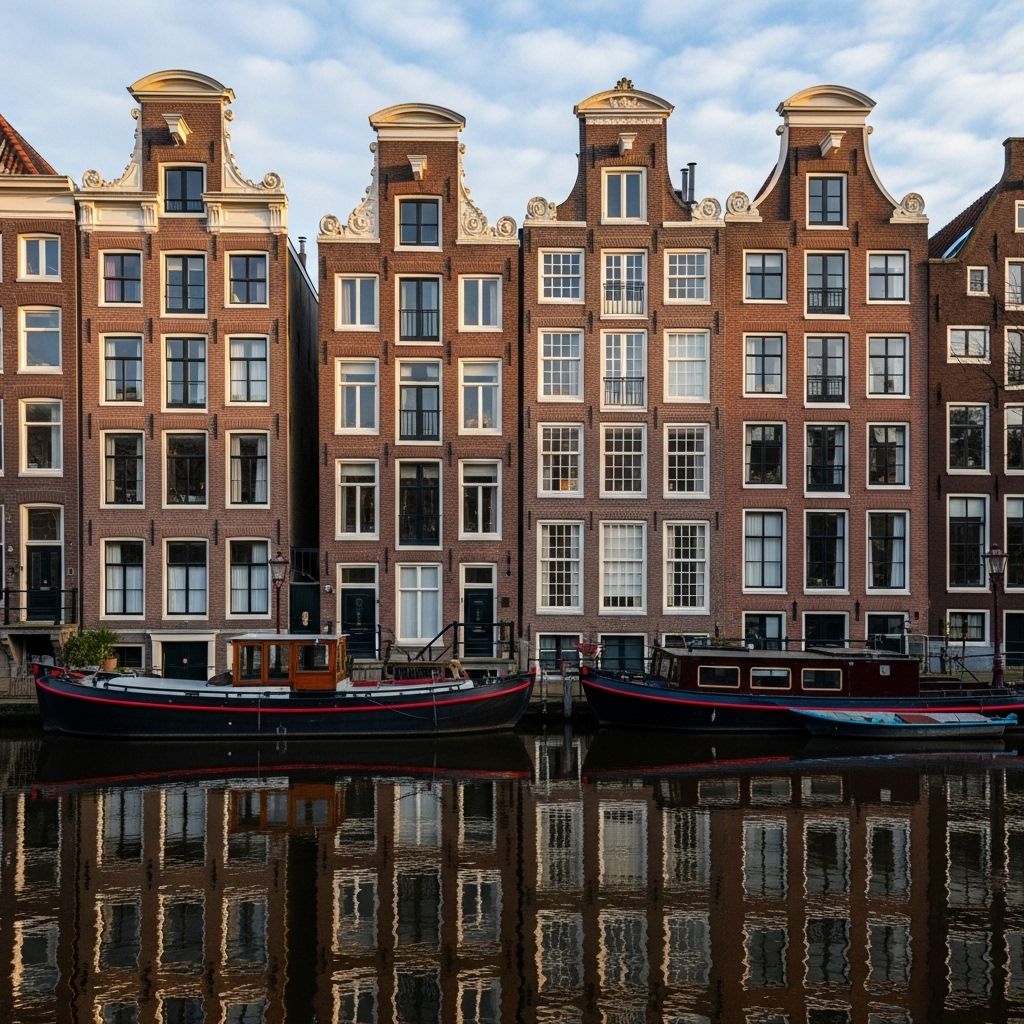
The distinctive form of the Amsterdam canal house — narrow frontage (typically 6–8 metres wide), deep footprint (15–25 metres), three to five storeys — was not merely an aesthetic choice. It was determined by a taxation system that assessed property on frontage width. This geometry created a specific thermal engineering challenge: how to heat a building that was, in effect, a tall narrow chimney, with large windows on the street side that admitted ample daylight but also permitted enormous convective and radiative heat loss.
The open fireplace — the dominant heating technology across northern Europe until the 18th century — was poorly suited to this environment. It emitted radiant heat in a narrow forward arc, drew enormous quantities of room air into its draught, and wasted the majority of its combustion energy up the chimney. In a wide English manor hall or a French château salon, this was a manageable inefficiency. In a narrow Amsterdam canal house room where the external walls were cold and the windows single-glazed, an open fire often managed to raise the air temperature by only a few degrees above ambient on the coldest days.
Dutch builders and craftsmen, responding to the demands of wealthy merchants who expected rather more from their expensive houses, developed a different approach: the enclosed stove, clad in ceramic tiles that would absorb combustion heat, store it in their thermal mass, and release it slowly and evenly into the room over many hours.
"The tile stove was not simply a piece of furniture. It was a precision thermal instrument — and the Amsterdam craftsmen who built them understood heat storage in ways that anticipate modern passive building design by three centuries."— I. Steenhoven, Warmte in de Gouden Eeuw, Amsterdam University Press, 2021
The Tegelse Kachel: Engineering Principles
The classic Dutch tile stove was a masonry or iron core structure — the Kachelkern — encased in a grid of square ceramic tiles typically 130 × 130 mm in size. The core contained the firebox, where combustion took place, and a series of baffled flue channels designed to maximise the path length of hot combustion gases before they exited to the chimney. This serpentine or labyrinthine gas path — sometimes described as the "Zug" or "Zugführung" in contemporary German technical literature — ensured that the maximum possible fraction of combustion heat was transferred to the ceramic mass of the stove body before the gases were lost.
The thermal engineering underlying this design is straightforward but elegant. Ceramic tiles have a specific heat capacity of approximately 800–900 J/(kg·K) and a density of 1800–2200 kg/m³, giving a volumetric heat capacity of 1.44–1.98 MJ/(m³·K). A fully fired tile stove weighing 400–600 kg could store 90–135 MJ of thermal energy — enough to maintain comfortable room temperature for 12 to 18 hours from a single firing. This is the principle of thermal mass storage: concentrate energy input in a short period (the firing, typically 1–2 hours with a rapid, hot fire), store it in high-capacity materials, and release it slowly over many hours through the low-temperature radiating surface of the tile cladding.
The surface temperature of the fired tiles was intentionally kept below 100°C — often closer to 50–70°C after the initial peak — so that radiant heat transfer to room occupants and furnishings was gentle and non-desiccating. This contrasts sharply with the surface temperature of a cast-iron stove (which may reach 300–500°C in the firebox area) and produces a quite different thermal environment: the room warms evenly from all directions rather than intensely from one.
The Delftware Aesthetic: Where Engineering Meets Art
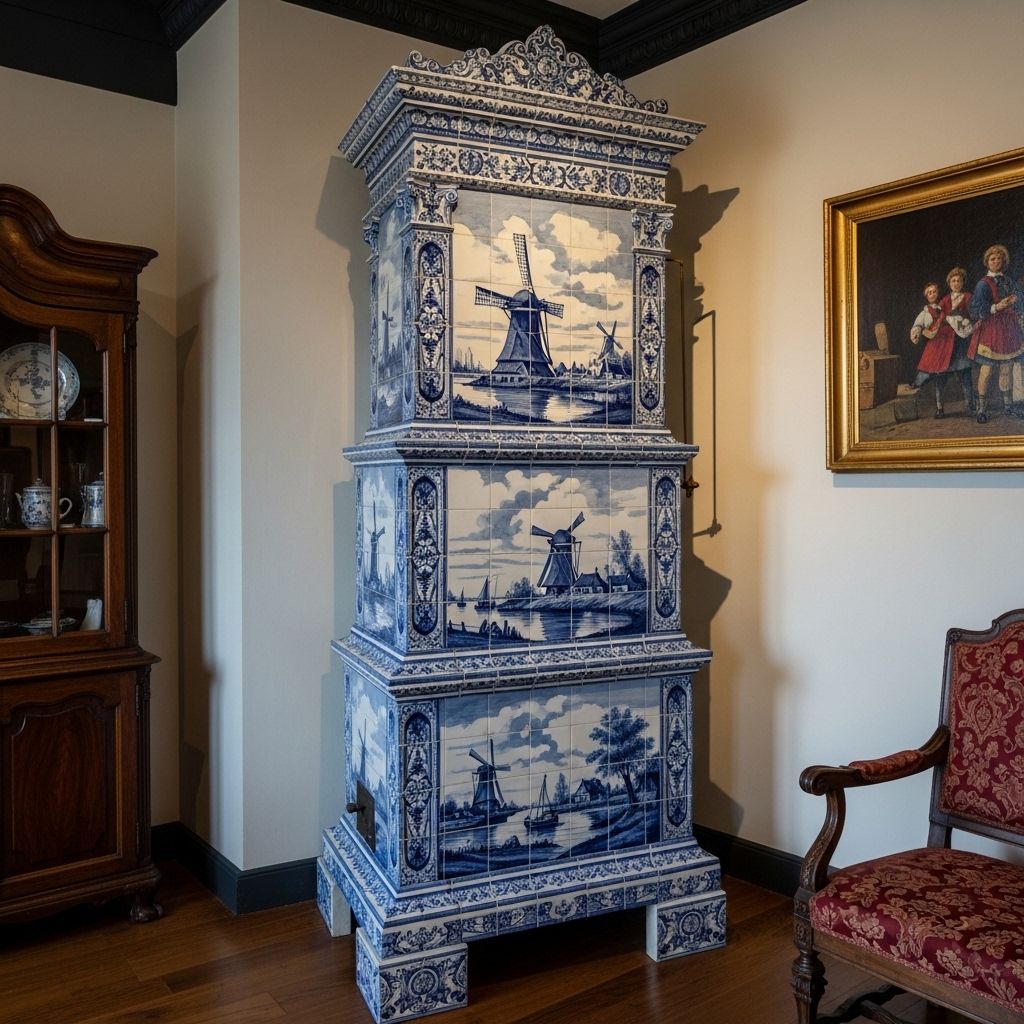
The tile stove achieved its most refined form in the 17th and 18th centuries, when the growth of the Delftware ceramic industry provided Amsterdam's wealthy merchant class with an extraordinary range of decorative tile options. The characteristic blue-and-white palette of Delftware — inspired initially by Chinese blue-and-white porcelain arriving via the VOC trade — became the visual language of the prosperous Dutch interior, applied to floor tiles, fireplace surrounds, and — most spectacularly — stove cladding.
A masterwork tile stove might feature a continuous pictorial programme across its entire surface: a sequence of landscape or seascape panels running around the firebox, pastoral scenes on the upper panels, decorative borders in geometric or floral patterns, and a cornice of specially moulded architectural tiles at the top. The pictorial tiles were not merely decorative; they were status objects, visible demonstrations of the owner's ability to afford not only warmth but the most sophisticated ceramic artworks of the age.
The tile makers of Delft, Rotterdam, and Amsterdam developed specific tile forms for stove applications: thicker body construction to handle repeated thermal cycling, a specially formulated glaze that could withstand temperatures above those encountered in wall tile applications, and standardised dimensions that allowed tile setters to construct stoves of varying sizes from a common module. The craft of the kachelzetter — the tile stove builder — was a recognised trade guild speciality in Dutch cities by the early 17th century.
Combustion and Carbon: What the Stoves Left Behind
The firing regime of the tegelse kachel had direct implications for combustion chemistry and the accumulation of carbon deposits. The ideal firing protocol called for a rapid, hot fire using dry hardwood (typically oak, beech, or hornbeam) that would quickly bring the firebox to operating temperature, transfer the maximum possible heat to the ceramic mass, and then die down to coals and ash. This high-temperature, short-duration firing promoted near-complete combustion and minimised soot and creosote deposition in the internal flue channels.
In practice, however, the use of wet or unseasoned wood — always a temptation for households seeking to economise on fuel costs — produced the opposite result. Wet wood burns at lower temperatures, generates more smoke (containing water vapour, unburned volatiles, and incipient soot particles), and deposits tar and creosote on the cooler interior surfaces of the baffle channels. Over the decades, these deposits could partially block the internal flue passages, reducing the stove's thermal efficiency and, in extreme cases, creating the conditions for a dangerous internal flue fire.
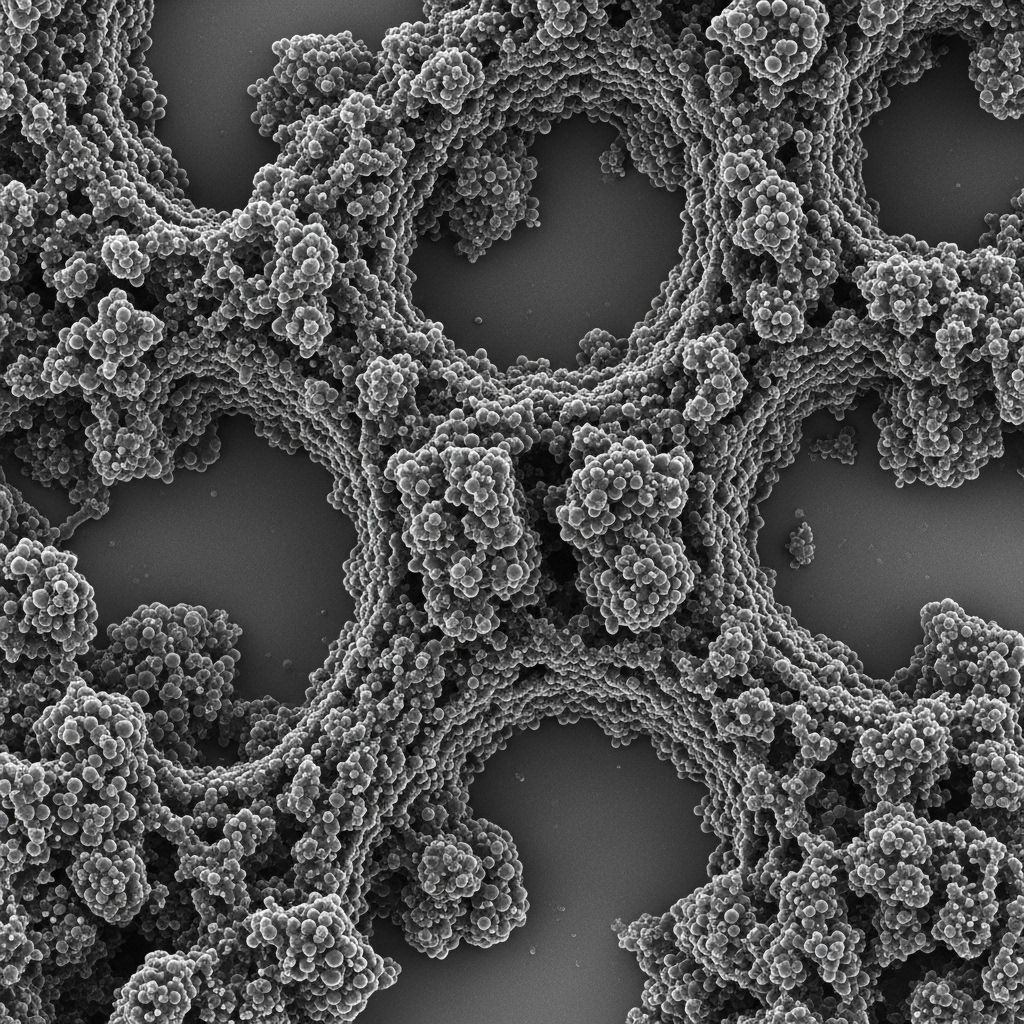
The carbon chemistry of stove deposits from this period has been studied archaeologically. Analysis of soot samples from intact 17th- and 18th-century stove chambers in Amsterdam canal house museums reveals the characteristic PAH fingerprints of wood combustion — notably fluoranthene, pyrene, and benzo[b]fluoranthene — alongside inorganic ash components reflecting the mineral content of the wood fuel. These chemical profiles serve as evidence of the fuel types used, the combustion temperatures achieved, and even — through isotopic analysis — the geographic origin of the timber.
The Transition to Coal, Iron, and Gas: 1800–1960
The tile stove's dominance of Dutch domestic heating began to erode in the 19th century as industrialisation transformed both fuel supply and manufacturing capability. The expansion of the coal trade — facilitated by the Dutch canal and rail network — brought a fuel with very different combustion characteristics: higher energy density, slower burn rate, and different (and in some respects more hazardous) combustion byproducts including sulfur dioxide and higher concentrations of certain PAHs.
Cast-iron stoves, manufactured at scale in the industrial foundries of the Rhine valley and imported into the Netherlands, offered cheapness and simplicity over the bespoke craftsmanship of the tile stove. By 1880, mass-produced iron stoves had displaced the tegelse kachel in all but the most conservative wealthy households. The visual language of comfort changed: the decorative tile surface gave way to the austere black iron silhouette of the Kanonofen or its Dutch equivalents.
The next great transformation came after the Second World War, and particularly after the 1959 discovery of the Groningen natural gas field at Slochteren — at the time the largest natural gas reserve discovered in the world. The Dutch government's decision to rapidly convert the national energy supply to natural gas produced one of the fastest fuel transitions in European history: within a decade, the majority of Dutch households had switched from coal and oil to gas central heating. By 1971, the cast-iron stove and the kitchen range had been largely superseded by the central boiler and the radiator.
District Heating: The Legacy of Communal Thermal Management
The Netherlands today operates one of Europe's most extensive district heating networks, supplying warmth to residential and commercial buildings in Amsterdam, Rotterdam, The Hague, and dozens of smaller cities through a network of insulated underground hot-water pipes fed from centralised heat sources — waste heat from industrial processes, geothermal energy, and combined heat-and-power (WKK) plants. In 2024, approximately 10% of Dutch households were connected to district heating networks, with government targets aiming to increase this to 25–30% by 2030 as part of the national Warmtetransitie (heat transition) programme.
There is a pleasing historical continuity here. The tegelse kachel was, in essence, a thermal mass storage device that decoupled the timing of fuel combustion from the delivery of warmth to the building occupants. Modern district heating networks operate on a similar principle at urban scale: heat is generated centrally and efficiently (often as a byproduct of processes that would otherwise waste it), distributed through an insulated pipe network, and delivered to homes through local heat exchangers. The logic of thermal mass, thermal distribution, and thermal decoupling that the Dutch kachelzetter understood intuitively in 1650 is now being applied at the scale of entire cities.
Preservation and the Living Legacy of the Tile Stove
Approximately 2,000 to 3,000 original 17th- and 18th-century tile stoves survive in the Netherlands, the majority in museum collections and preserved historic interiors. The Rijksmuseum holds the most significant collection, including several complete stoves from demolished canal houses. The Amsterdam Museum and the Gemeentemuseum in The Hague hold additional examples, while private collections in historic country estates (buitenplaatsen) account for a substantial number of surviving specimens.
Conservation of these objects presents specific challenges. The ceramic tiles are generally stable, but the mortar joints between tiles and the iron internal hardware are susceptible to thermal fatigue cracking — a consequence of centuries of expansion and contraction cycles. Where stoves are maintained in functioning condition for demonstration purposes, conservators specify strictly controlled firing regimes using only dry, low-sulfur wood, with strict monitoring of both firebox and tile surface temperatures.
There is also a small but growing market for new tile stoves built by specialist craftspeople in the historical tradition, particularly in the Benelux countries and Germany. These contemporary kachels combine modern refractory materials and precision-engineered baffle geometries with handmade ceramic tile cladding, achieving efficiencies of 85–90% while preserving the aesthetic language and thermal comfort characteristics of their 17th-century predecessors. They represent, in a very direct sense, the continuation of an engineering tradition that stretches back four centuries.
Key References
- Steenhoven, I. (2021). Warmte in de Gouden Eeuw: Keramische kachels in het 17e-eeuwse Amsterdam. Amsterdam University Press.
- Pluis, J. (1997). De Nederlandse tegel: Decors en benamingen 1570–1930. Primavera Pers, Leiden.
- Macarthy, J. (2014). Dutch tile stoves: Engineering, aesthetics, and thermal performance. Construction History, 29(2), 1–28.
- Centraal Bureau voor de Statistiek (CBS). (2024). Energiebalans Nederland 2023. Statistics Netherlands, The Hague.
- Ministerie van Economische Zaken en Klimaat. (2023). Programma Warmtetransitie: Voortgangsrapportage 2022. The Hague.